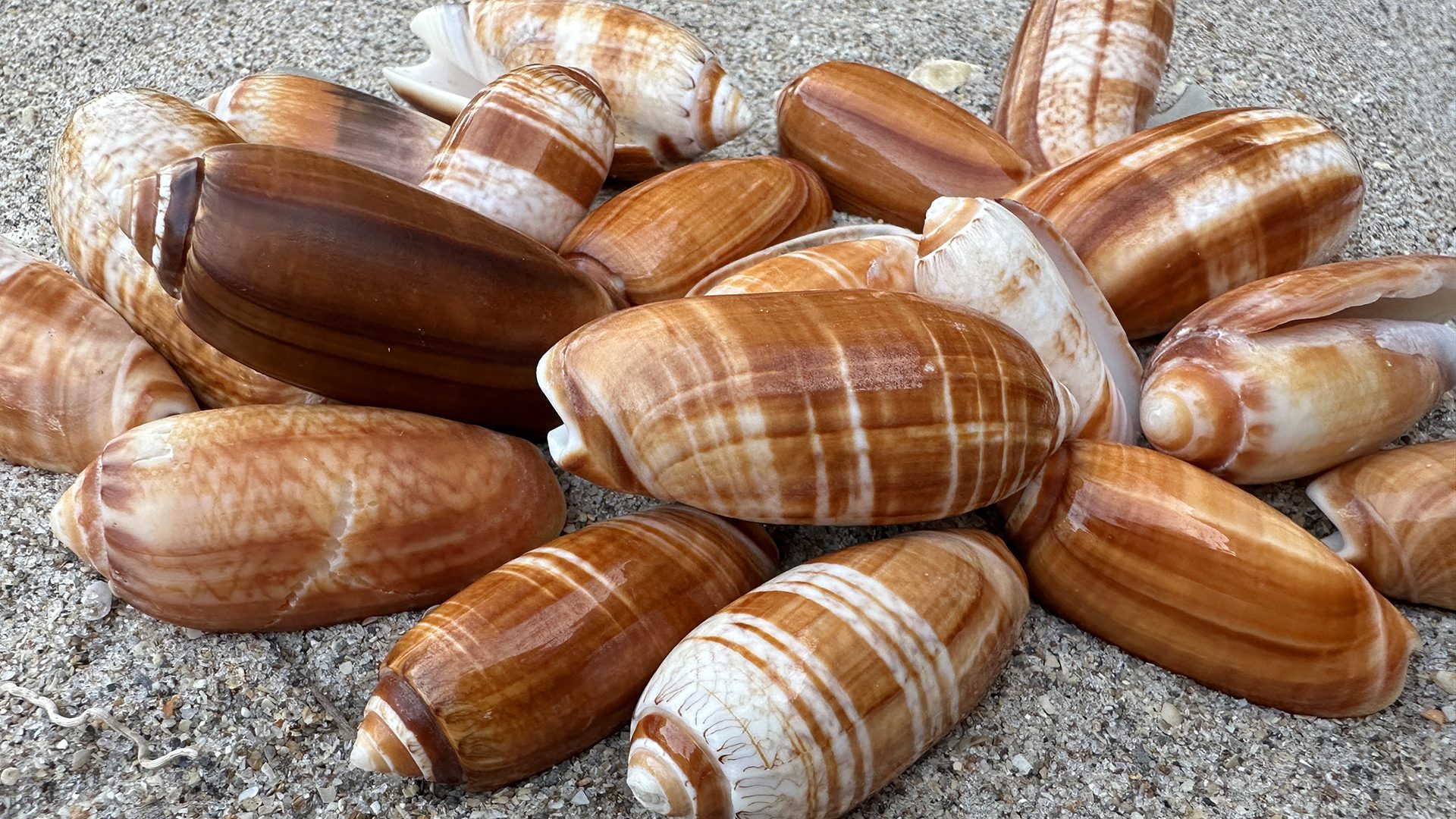
Updated Post, Sept. 11, 2025: Learning about olive “forms” has been quite confusing. These brown olives in particular. From what I can gather put simply southeast Florida has 2 species. Note: I’m trying to keep current with the name trails on WoRMS (World Register of Marine Species) :
1) Oliva sayana (Ravenel, 1834) which is the
Lettered Olive
2) Oliva nivosa (Marrat, 1871) which is the Netted Olive >> old name is Oliva reticularis and accepted alternative name by WoRMS is Oliva (Americoliva) nivosa
The brown olives fall under O. nivosa as a subspecies, which is Oliva nivosa bollingi (Clench, 1934) that is accepted as a subspecies by WoRMS in the genus Oliva. Synonymised names that have the status of “unaccepted” by WoRMS, regarding the same subspecies is : Americoliva bollingi bollingi, and Americoliva nivosa bollingi. (The original name of Oliva nivosa bollingi was Oliva reticularis bollingi.) Those who accept bollingi as a species under Americoliva as an independent genus, agree that all netted olives are bollingis in different color forms; but according to WoRMS which is the official world registry, netted olives are nivosa with bollingi only being a sub-species under Oliva as the traditional genus. There is an ongoing debate ever since Americoliva has been treated as an independent genus from the traditional WoRMS accepted genus classification of Oliva, in which Americoliva is treated as a subgenus of Oliva.
The current common name of these brown olives (stripped and/or solid) are Bollingi or Bolling’s Olive. Photos by the shell museum.
Original Post: The first time I heard of a Fulgurator Olive (Oliva fulgurator, Röding, 1798) was when a friend of mine showed me the one her daughter collected on Sanibel Island and was trying to figure out what it was. The next experience I had with them was finding them myself in dredge piles in Palm Beach! Wow those were the HOT shells to find in the piles there for sure! I pulled lots of them out of the dredge piles in 2 different color forms, at that time not knowing the difference I used the name Fulgurator and Bollingi interchangeably (as most other shellers did at those piles).
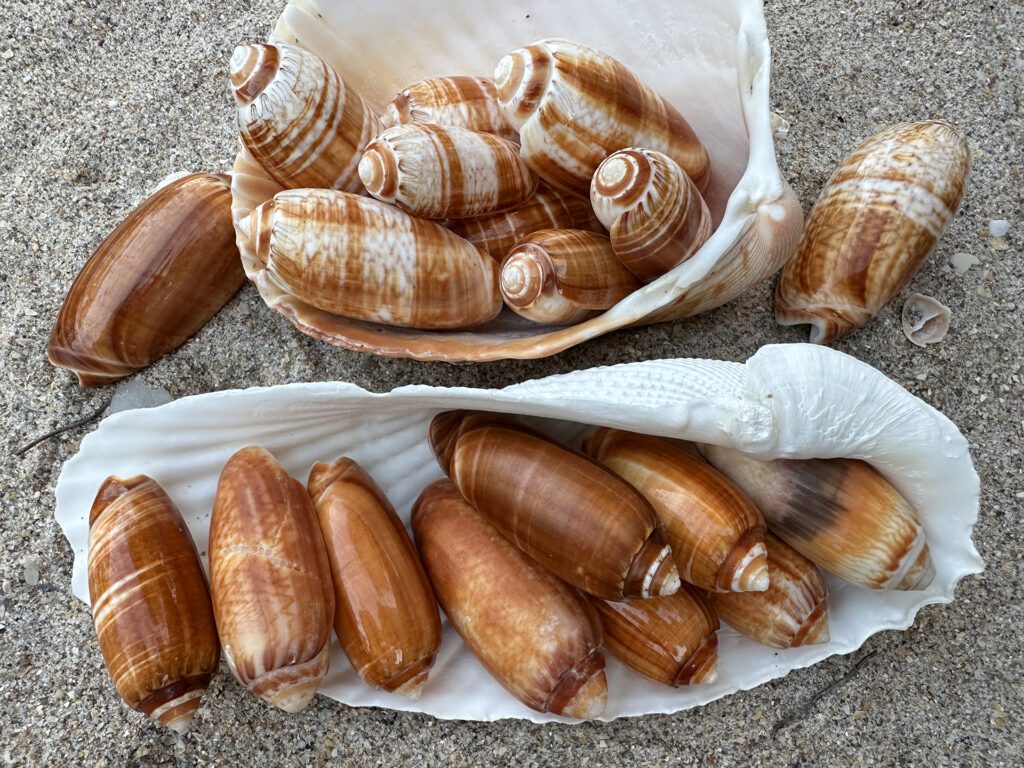
When I uploaded those dredging episodes to my YouTube channel, I received some comments that lead me to the correct form names for the ones I found. They were all “Fulgurator” Olives but I had found 2 different “forms” of them. I found the forms bifasciata and form formosa. Which are both brown olives. A bollingi is a form of Fulgurator Olive but the bollingi form is not brown like the ones I found. I have learned that there are about 7 different forms of Fulgurator Olives:
bifasciata
bollingi
circinate
formosa
jamaicensis
olorinella
reticularis
In researching these I’ve come across several different name combinations of the 7 different Fulgurator forms. Then I landed on the website “Let’s Talk Seashells” by Marlo F. Krisberg, I was SO happy to find a comprehensive chart on Fulgurators with the 7 different forms of them and that chart page on his site is connected to Jaxshells which goes into even more detail!
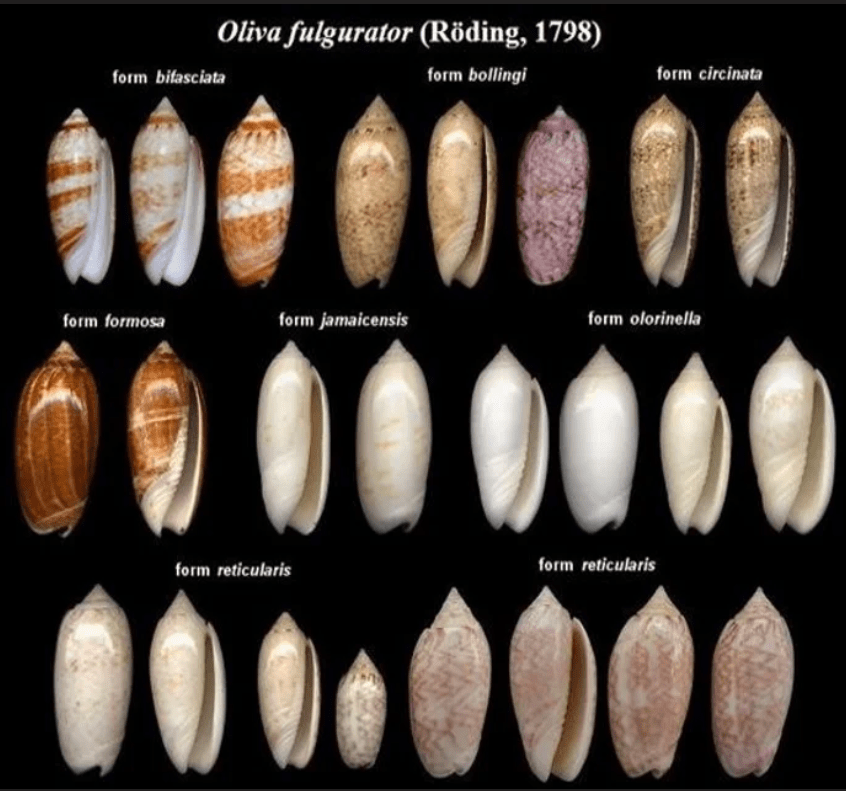
In looking at this chart I noticed the Fulgurator form reticularis which is commonly referred to as a Netted Olive (Oliva reticularis) and one comment on my YouTube video about a Fulgurator, was it wasn’t a Fulgurator olive it was Oliva bifasciata but bifasciata IS a “form” of Fulgurator…you see how these names/forms can get confusing? The fact of the matter is that Oliva fulgurator has been presented under several names due to its diverse color variations. It’s like a puzzle of a multiform species.